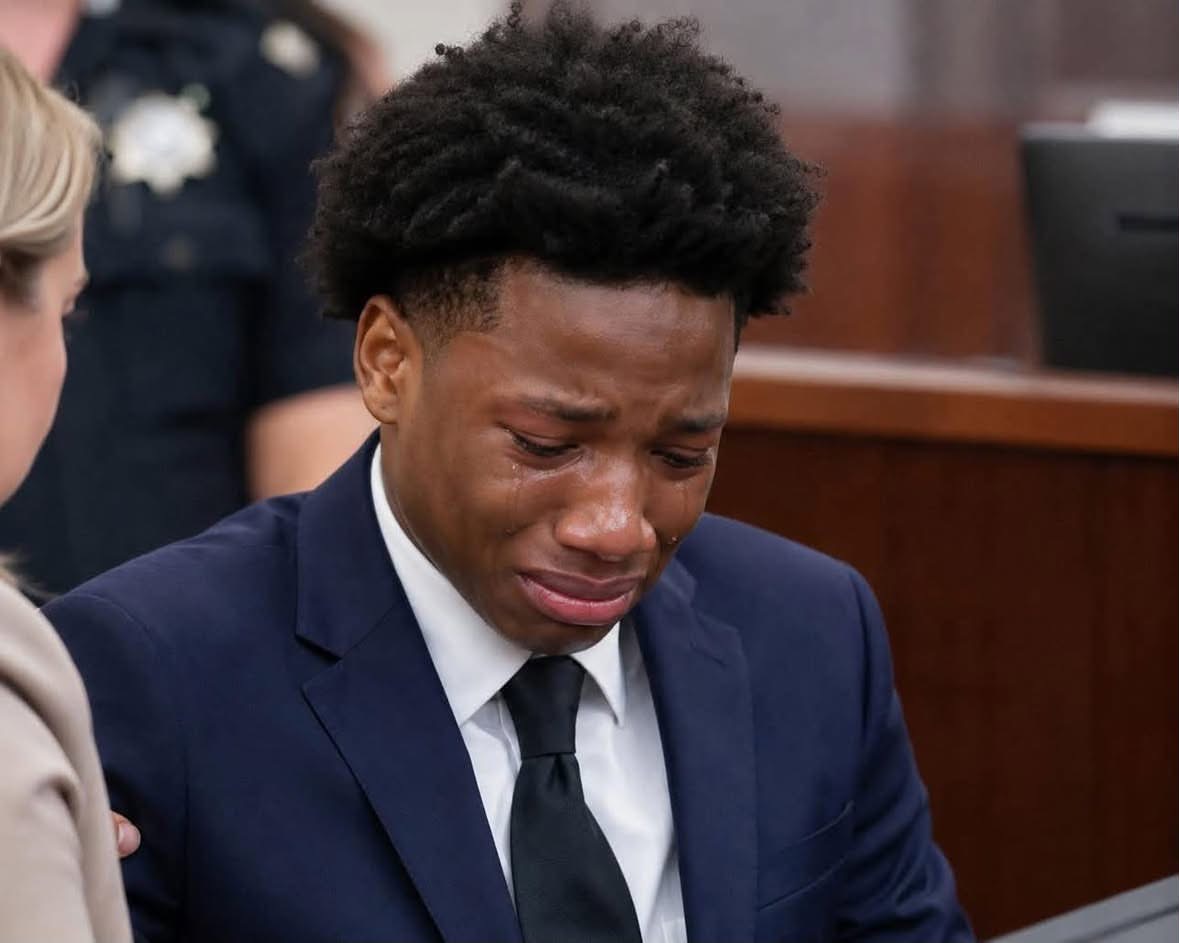
The murder conviction of 19-year-old Karmelo Anthony in the fatal stabbing of 17-year-old Austin Metcalf has become more than a criminal case. It is now a public test of how Americans understand fairness, race, jury selection, and institutional legitimacy.
At the center of the case is a tragedy: the death of Austin Metcalf and the conviction of Karmelo Anthony. But surrounding the criminal facts is a deeper institutional question; one that does not depend on guilt or innocence: how does a justice system prove that its decision process is fair when the public cannot clearly see how the final decision-makers were selected?
The issue is no longer theoretical. A 19-year-old Black defendant has been sentenced to 35 years in prison by a jury seated through a process that reportedly included no Black jurors. Whether the verdict is upheld or appealed, the governance question remains: can the justice system explain, audit, and defend the fairness of the decision pipeline that produced this outcome?
That question matters because the jury is not merely a group of citizens. In a criminal trial, the jury is the human decision system that determines liberty, punishment, and, in some cases, a lifetime behind bars. When that system operates as a black box, public trust does not erode gradually: it collapses.
Neutrality at the Input Is Not Fairness at the Output
This is where the case becomes relevant to AI governance, and the parallel is not rhetorical.
In AI governance, we already understand that a system can be technically neutral while still producing unfair outcomes. A vendor may claim its algorithm is "objective" because it uses automated scoring. A company may claim its hiring tool is "neutral" because it applies the same model to every applicant. A court system may claim its jury process is "fair" because names are randomly drawn. In each instance, the claim rests on the same flawed premise: that neutrality at the input stage guarantees fairness at the output stage.
It does not. That is the central problem.
Texas jury lists are drawn from administrative data sources: voter registration rolls, driver's license records, and state identification records. From there, people are summoned, screened, questioned, excused, challenged, struck, and finally seated. At every stage, the pool becomes smaller. At every stage, discretion enters the system. At every stage, a demographic group that is already numerically smaller becomes more vulnerable to elimination.
In AI governance terms, the jury master list is the dataset. The summons process is the sampling layer. The questionnaire is a filtering model. Voir dire is human review. Peremptory strikes are discretionary overrides. The seated jury is the final output.
If this were a vendor algorithm, no serious governance professional would accept the answer: "The model is fair because the initial input was random." We would demand data lineage, source validation, bias testing, disparate-impact analysis, audit logs, override justification, and outcome monitoring. The justice system should be held to no lesser standard.
The Demographics of Collin County
Collin County, Texas is not a rural, overwhelmingly white county. It is a large, diverse, fast-growing county with a population of roughly 1.25 million people. Census-linked data place the county at approximately 47.9% non-Hispanic White, about 16% Hispanic or Latino, 17–21% Asian, and roughly 10–12% Black or African American, depending on the Census categories applied.
The Black population is not large enough to dominate a random jury draw. But it is large enough that its complete absence from a racially sensitive murder trial demands scrutiny. This is not a call for racial quotas. It is a call for accountable randomness.
If Black residents represent roughly 10% of the eligible jury population, a purely random 12-person jury would be expected to include approximately 1.2 Black jurors. Because juries are small, the odds of seating zero Black jurors are still meaningful: approximately 28.2% at a 10% share, and 21.3% at a 12.1% share. An all-non-Black jury is mathematically possible, but possible does not mean acceptable without audit.
The concern deepens when alternates are included. For an 18-person group of jurors and alternates, the probability of having zero Black members drops to roughly 15.0% at a 10% share and 9.8% at a 12.1% share. These are not impossible outcomes. But they are low enough to function as a fairness signal, particularly in a case involving a Black defendant, a white victim, national racial attention, and reports that Black prospective jurors were removed through peremptory strikes.
At that point, the process stops looking merely random and starts looking like a black-box decision pipeline.
The Limits of Batson
The legal system may argue that jury selection already has safeguards. The primary one is the Batson v. Kentucky challenge, which prohibits race-based peremptory strikes. But Batson is not sufficient if race-neutral explanations can mask proxy discrimination.
In AI governance, we know proxy variables matter. A model does not have to use race explicitly to produce racially disparate outcomes. Zip code, education, employment history, income, and occupation can all function as proxies for race, producing racially skewed outputs while remaining defensible on their face.
The same concern applies to jury selection. If Black prospective jurors are removed because they are "educators," the governance question is not simply whether "educator" is a race-neutral category. The deeper question is whether that explanation operated as a proxy for removing the remaining Black jurors from the panel. If non-Black jurors with comparable backgrounds (child-centered, school-related, public-service, or otherwise sympathetic profiles) were retained, then the stated justification warrants rigorous comparative review.
That is not activism. That is audit logic.
The Transparency the System Cannot Provide
The most serious issue is not only that no Black jurors were seated. It is whether the public can evaluate how that happened.
How many Black residents were in the original jury wheel? How many were summoned? How many appeared? How many were qualified? How many survived the questionnaire stage? How many reached voir dire? How many were removed for cause? How many were removed by peremptory strikes? Were similarly situated non-Black jurors treated differently?
Without those answers, the system asks the public to trust an output without seeing the process. That is precisely what responsible governance rejects, in AI systems and in courtrooms alike.
The Structural Risk of Elected Justice
The political environment surrounding this case makes the governance concern even more urgent. In Texas, many key actors in the criminal-justice pipeline (judges, prosecutors, sheriffs) are elected officials. Elected systems are responsive systems. And in high-profile cases involving racial tension and public anger, responsive systems face structural pressure to produce outcomes that satisfy the majority rather than protect the individual.
The concern here is not that any particular official acted politically in this case. The concern is structural: when public anger, media attention, electoral incentives, and racial tension converge, the justice system must be equipped to insulate its decisions from majoritarian pressure.
Courts do not exist to appease the largest or loudest constituency. They exist to protect due process, including when the defendant is unpopular, when the case is emotionally charged, and when the public is angry. A justice system that becomes excessively sensitive to majority pressure risks becoming a system of public appeasement rather than constitutional adjudication.
For Black Americans, this concern is not abstract. The history of American criminal justice includes exclusion from juries, discriminatory prosecution, racialized punishment, and deep-rooted institutional distrust built on real institutional harm. Against that history, a racially sensitive trial with no Black jurors seated cannot be dismissed as a minor statistical anomaly. It must be treated as an institutional warning.
The Speed of the Verdict
The fact that the jury reportedly reached a murder verdict in fewer than three hours does not, by itself, make the verdict unlawful. But in a case involving a self-defense argument, contested intent, manslaughter as a potential alternative, racial tension, and the complete absence of Black jurors, a rapid decision raises a serious governance concern: did the decision-making body engage meaningfully with the full complexity of the case, or did the process produce a fast output that the public is now expected to accept without sufficient transparency?
What a Modern Jury Accountability Framework Requires
The correct response to this case is not to attack the jurors. It is not to deny the gravity of Austin Metcalf's death. It is not to assume that every actor in the courtroom was motivated by racial intent. The correct response is to demand transparent, measurable, and auditable jury selection.
A modern jury accountability framework should include:
- Demographic reporting at each stage of the jury pipeline, from the source list through final seating
- Validation of the jury source list against eligible county demographics, with identification of underrepresentation at the population level
- Public aggregate data on summons response rates and excusal patterns by demographic group
- Anonymized reporting of for-cause removals and peremptory strikes
- Comparative juror analysis when Batson challenges are raised, examining whether similarly situated jurors of different demographics were treated differently
- Independent review of strike patterns in racially sensitive cases
- Preservation and public accessibility of jury-selection records for appeal and institutional accountability
This is the difference between a system that is merely random and a system that is actually fair.
Conclusion: Justice Is More Than Randomness
Across the United States, most county-level court systems sit in counties where non-Hispanic White residents remain the majority or largest population group. Juries are drawn locally, and local court systems often reflect the demographic and political structure of the counties in which they operate. Even in a diverse county like Collin County, the jury-selection pipeline can produce majority-heavy outcomes if minority residents are underrepresented at any stage: the source list, summons response, qualification, excusal, voir dire, or peremptory strikes.
A system can be random and still be unfair to minorities. A system can be technically lawful and still produce outcomes that damage public legitimacy. A system can avoid explicit racial language and still eliminate minority voices through proxy reasoning.
That is why the urgent question raised by the Karmelo Anthony case is not only what happened in one courtroom in Collin County. The urgent question is whether courts across the United States are prepared to open the black box of jury selection and demonstrate, with data and not procedure, that justice is not being shaped by demographic imbalance, discretionary opacity, or majoritarian pressure.
In AI governance, we no longer accept black-box systems that affect people's lives without transparency, validation, and accountability. A criminal jury is among the most consequential decision systems in American life. It should not be less auditable than a vendor algorithm.
If the justice system demands public trust, it must provide public accountability.
Justice is more than randomness. True justice is systematically fair.